The More We Know, the More We Can Choose
Turning health knowledge into healthier choices
Most of us know more about health today than we did ten years ago.
And ten years from now, we will probably know even more.
That is one of the remarkable things about health. There is always something new to understand—not only from science and medicine, but from paying attention to our own bodies, our families, and the patterns of our everyday lives.
We know that drinking water is important.
We know that vegetables are good for us.
We know we should move our bodies, get enough sleep, and find ways to manage stress.
None of those ideas are particularly surprising.
But sometimes, learning just a little more changes the way we think about something we thought we already understood.
Consider hydration.
We often think about hydration simply as drinking enough water. But our bodies also receive water from the foods we eat. Fruits, vegetables, soups, yogurt, and other water-rich foods contribute to our overall hydration too.
Suddenly, “stay hydrated” becomes a little more interesting.
Or consider movement.
Many of us grew up thinking exercise only really counted if we put on workout clothes and spent an hour doing something strenuous. But health benefits can also come from the movement woven throughout an ordinary day—walking, gardening, climbing stairs, carrying groceries, playing with grandchildren, or simply getting up from our chairs more often.
That changes the question from:
Did I exercise today?
to:
How much did I move today?
A small piece of knowledge can change a choice.
And a small choice, repeated often enough, can begin changing a life.
“A small piece of knowledge can change a choice. And a small choice, repeated often enough, can begin changing a life.”
Curiosity May Be One of Our Healthiest Habits
There is a concept in healthcare called health literacy.
At its simplest, it means being able to find, understand, and use information that helps us make better decisions about our health.
And perhaps the most important word in that definition is use.
Knowing something is valuable.
Doing something with what we know is where the opportunity begins.
- We can learn that fiber is important and decide to add beans to dinner twice this week.
- We can learn that sitting for long periods isn’t ideal and begin taking a five-minute walk between meetings.
- We can learn how important sleep is to metabolism, mood, memory, and recovery and decide that bedtime deserves the same protection we give other appointments on our calendar.
We don’t have to learn everything.
We simply have to remain curious enough to keep learning—and willing enough to occasionally let what we learn change what we do.
Start With Your Own Health
One of the best places to become more curious is surprisingly close to home.
Your own health.
- Do you know your blood pressure?
- Do you understand what the numbers from your last blood work mean?
- Do you know whether certain health conditions tend to occur in your family?
- Do you understand why your healthcare provider recommends a particular screening—or when you should have it?
- Do you know what your medications are intended to do?
These aren’t questions meant to make health feel like homework.
They are invitations to participate.
Healthcare works best when we aren’t simply passengers in the process.
- Ask questions.
- Write things down.
- Bring questions to appointments.
- Use credible health resources.
- Ask your healthcare provider to explain something again if it doesn’t make sense the first time.
And perhaps most importantly, ask:
What can I do with this information?
Because information becomes powerful when it leads somewhere.
Then Make It Small Enough to Do
One of the easiest ways to become overwhelmed by health information is to try to act on all of it at once.
We read an article and suddenly decide we’re going to completely change our diet, exercise every morning, sleep eight hours, meditate, drink more water, eliminate stress, and become an entirely different person by next Tuesday.
There may be a gentler approach.
Learn one thing.
Choose one action.
Practice it.
Then learn something else.
- Perhaps you learn that walking after meals can be a simple way to add movement to your day. So instead of designing an elaborate new fitness routine, you begin with a ten-minute walk after dinner.
- Perhaps you learn that sleep thrives on consistency. Instead of completely redesigning your evenings, you start by going to bed at roughly the same time most nights.
Knowledge doesn’t always have to produce dramatic change.
Sometimes it simply helps us make the next choice a little better.
What We Learn Rarely Stops With Us
There is another beautiful thing about becoming more knowledgeable about our health.
We talk.
- We tell our spouse about something interesting we learned.
- We prepare a healthier meal and our children eat it too.
- We invite a friend on our evening walk.
- We tell our parents why knowing their blood pressure matters.
- Our grandchildren see that movement is simply something our family does.
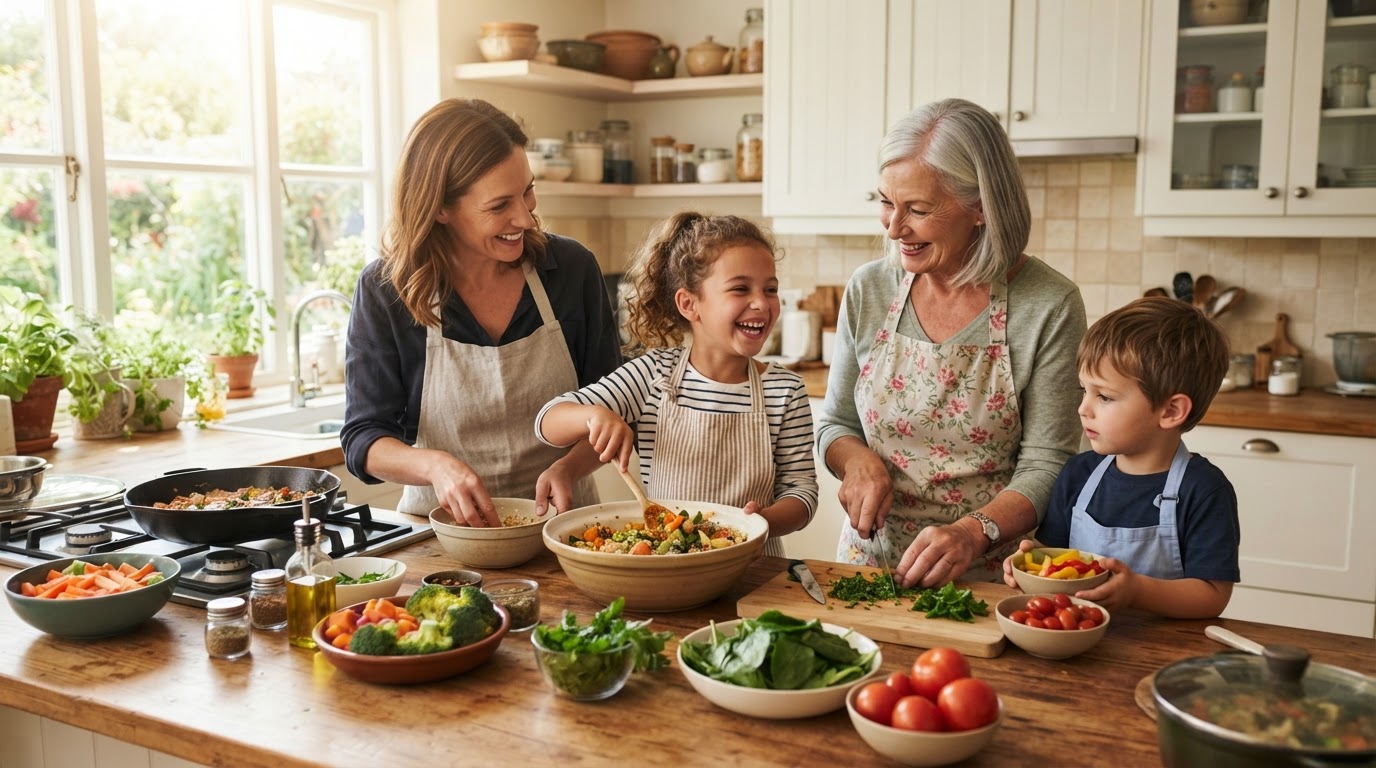
Over time, individual choices can become family habits.
And family habits can become part of a family’s culture.
That is one way we can begin thinking about generational health.
We often talk about what families pass from one generation to another in terms of genetics. And genetics certainly matter.
But families pass along something else too.
- Recipes.
- Routines.
- Attitudes toward exercise.
- Ways of coping with stress.
- Sleep habits.
- Relationships with food.
- Whether preventive healthcare is prioritized.
- Even the language we use when we talk about our bodies and our health.
Those patterns can travel through generations too.
Which means something hopeful:
We have the opportunity to pass along healthier ones.
“Those lessons may never appear in a medical chart. But they may influence health for decades.”
Imagine a child growing up in a family where taking a walk after dinner is ordinary.
- Where vegetables aren’t “diet food.” They’re simply food.
- Where people talk openly about their health.
- Where asking for help is considered wise.
- Where rest isn’t something you have to earn.
- Where getting older isn’t viewed only as decline, but as another reason to take good care of the body carrying you there.
Those lessons may never appear in a medical chart.
But they may influence health for decades.
There Will Always Be More to Learn
Health information can sometimes feel overwhelming.
One week we’re hearing about protein.
The next it’s gut health.
Then sleep, strength training, inflammation, hormones, fiber, hydration, or something entirely new.
We don’t have to chase every headline.
We don’t have to become experts.
And we certainly don’t have to turn healthy living into another source of pressure.
We can simply become thoughtful students of our own health.
Curious.
Willing to ask questions.
Interested in understanding our bodies a little better.
And prepared to turn useful knowledge into small, realistic actions.
Because ultimately, our health is shaped by thousands of ordinary choices made across thousands of ordinary days.
The more we understand those choices, the more intentionally we can make them.
And when the things we learn begin influencing the people we love, the impact may reach much further than our own lives.
At Broose Wellness, we believe knowledge should do more than tell us what is healthy.
It should help us understand why it matters, what we can do about it, and how small choices today can help create healthier tomorrows.
There is always more to learn.
And perhaps that isn’t overwhelming at all.
Perhaps it’s an opportunity.
A Thought to Carry With You
You don’t have to know everything about health to improve yours.
Learn something. Use something. Share something. Then stay curious.
One small discovery may change a choice today—and one healthier choice may travel further than you ever imagined.
Broose Watson, MD
Physician and Founder, Broose Wellness
Founder of Broose Wellness. With decades of experience in geriatric and lifestyle medicine, he is dedicated to helping individuals build healthier habits today for a more vibrant tomorrow.
